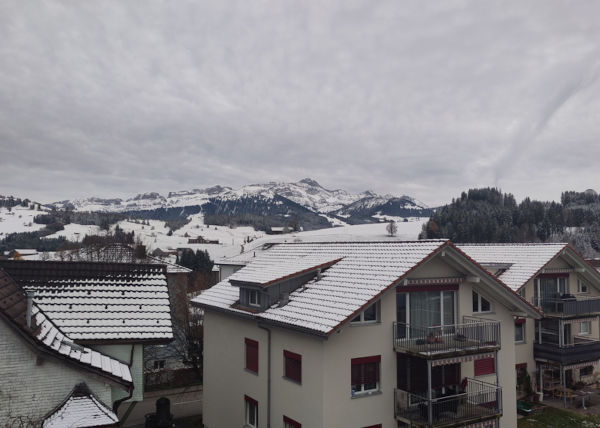
Snow covers the streets of Waldstatt. The surrounding hills are a beautiful white, and the sky announces that Winter energy is upon is. My usual walk at dusk through the local hills, which takes about an hour, is surprisingly empty of life: no deer, foxes, birds, or cows to be seen anywhere. The mighty Säntis mountain peaks out wearing a white coat as clouds hover at it’s shoulders. Everything seems to be slowing down.
Such a mood has its quality of acquiesce, of acceptance that long cold months are encroaching on our warm autumn days, nothing to change that, best not to strategize or evade the fact of entering a new winter season.
Other feelings might arise when cold approaches and days become very short. Endurance can seem to wane, motivation flattens out, our bodies don’t feel aligned with our appetites, and we might feel just plain tired all the time. The local Swiss woman who cuts my hair dreads winter. She has to drag her stiff body out the door and walk a few hundred meters to her salon, and her facial expression shows that she has to battle.
If I have a miserable relationship to the season, the cold, and the darkness, I might suffer. And that affects others around us.
I spent many years in close quarters with Shodo Harada Roshi. We were very privileged to see him from morning to night and how he dealt with tiredness, grumpiness, and frustration. He spent most of his waking hours helping us overcome such challenging mind-states, but once in a while, one could sense that he too was exhausted. I cannot overstate how hard this man works and how much he can accomplish in a day.
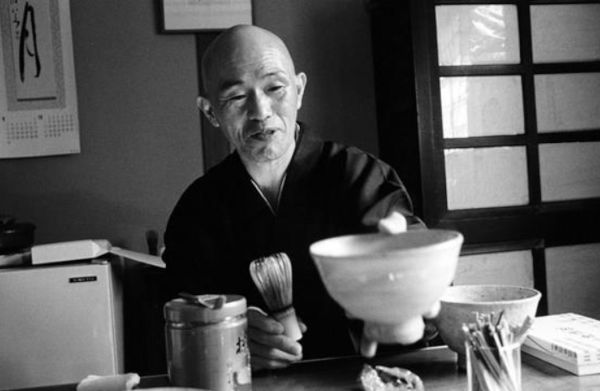
Over the years, I was brought to have tea with the Roshi for no apparent reason. Sometimes there would be chatter, but often there would be silence. The Roshi himself would at times make a matcha tea for himself, but more often he did not. He just offered. And what I also noticed as the effects of the tea and the Master’s presence elevated my spirits was that his sharing and giving as also his tool of regeneration. His generosity was also his source of rejuvenation.
Of course, giving is an art and the Roshi revealed often enough that he was a great student of life. I try to see this very deeply, because it seems to be a means of overcoming the difficulties that often arise at this time of year. In a strange way, our need for connection and fresh energy is zapped by our own consumer society. We are encouraged to consume more food, which might be appropriate. After all, the animals gain some substance in the cold season. But if our consuming is unhealthy, we often never shake the cold, heaviness, or loneliness. We take in more and more, but never feel truly satisfied. Only exhausted.
But, what if we shift our attention to the state of others? What can we offer them? What small thing can we do for them? How can we meet them, move with them, share ourselves with them so that we both reconnect to the rhythms of life that pulse through the snow, rain, and cold? If I see the vitality in this way of being in the world, I want to learn that art of generosity that the Roshi so beautifully embodies.
There is nothing new here. Dickens wrote hundreds of pages on this point in ‘A Christmas Carol’ and every Christmas film portrays the miracle of sharing hearts rather than being in conflict. And yet, we encounter challenges to embodying this wisdom. With the overwhelming pressure we m might face just to stay healthy, keep appointments, get the necessary Christmas gifts and cards prepared, and handle the heavy load of work that seems to increase at this time of year when energy is so costly, getting in touch with generosity might feel counter-intuitive. But the heart has tremendous power. It will brighten our tired bodies and minds when we sincerely connect and serve. Under the dull gray skies of Winter, we might just need a cue, a gesture to help us tap into it.
Good to get started, I think. I will drink a matcha tonight and think of Shodo Harada Roshi, but I hope to offer you one as well very soon!